

Reviewed · TOWNSHIP TOURS
Local Guided Walvisbay & Swakopmund Township Experience Day Tour
Township life tells a different story. This four-hour experience introduces you to Mondesa in Swakopmund through local families, music, food, and stories of the Owambo, Damara, and Herero communities. I like the chance to share a meal in a family home and the chance to hear guide Frans explain Namibia’s past in a personal, easygoing way.
I also like the mix of conversation and performance, from practicing the Damara Nama clicking language to seeing children sing and dance and finishing with a township choir. The main caution is practical: pickup is offered in Swakopmund only, and unclear meeting arrangements have caused real frustration for some customers, so confirm the exact location before the day.
In This Review
- Key points to know before booking
- Why Mondesa adds meaning to a Swakopmund visit
- Meeting guide Frans and choosing your transport
- The Damara Tower and Swakopmund’s colonial trading past
- Owambo, Damara, and Herero traditions
- Lunch at a local family home
- The DRC kindergarten and children’s performances
- Ending with the Mondesa choir
- What the $82.06 price includes
- Communication and timing deserve attention
- Who should book this Mondesa experience?
- FAQ
- Where does the tour take place?
- How long does the tour last?
- What time does the tour start?
- Is pickup included?
- How many people can join?
- Is lunch included?
- Can I cancel for a full refund?
- Should you book this tour?
Key points to know before booking

- A local look at Mondesa: Learn about township life, community traditions, and the Owambo, Damara, and Herero peoples.
- Food in a family home: Taste traditional Oshiwambo dishes and drinks in a setting that feels more personal than a restaurant.
- Music is part of the day: Children may sing and dance, and a local Mondesa choir provides the closing performance.
- Frans receives strong praise: He has been described as a warm guide, historian, singer, and patient host.
- Flexible transport choice: The tour includes use of a bicycle or car, depending on your choice.
- Small private groups: Bookings require at least two people and allow no more than ten.
Why Mondesa adds meaning to a Swakopmund visit

Swakopmund is often introduced through German colonial buildings, ocean activities, and desert excursions. Those experiences have their place, but they do not tell the whole story of the town. Mondesa offers a look at the communities and traditions that shaped modern Swakopmund.
This tour presents the township as living history. You move through areas connected with Owambo residents and learn about Damara and Herero customs along the way. The aim is not simply to point out buildings or recite dates. It is to connect places with people, family life, language, food, and music.
I like that approach because it gives you something to think about after the tour ends. You are not only collecting photographs. You are hearing how local traditions are expressed today and seeing how community groups keep music, language, and hospitality at the center of daily life.
The tour lasts about four hours, although the operator describes customized outings as lasting three hours or longer. That makes the experience reasonably easy to fit into a Swakopmund schedule, but you should not expect a tightly timed museum visit. The rhythm depends partly on conversation, meals, performances, and the people you meet.
More Township Tours in Walvis Bay:
- Walvis Bay: Mondesa Township Tour
★ 3.7 · 13 reviews - Windhoek: City and Township Tour
★ 4.8 · 430 reviews - Half-Day Windhoek City and Township Cultural Tour
★ 4.5 · 187 reviews
Meeting guide Frans and choosing your transport
The tour begins at 10:00 in the morning. Pickup is available in Swakopmund, but not in Walvis Bay according to the stated arrangements. If you are staying in Walvis Bay, you need to pay close attention to the meeting plan rather than assume a hotel or port pickup is included.
Frans is the guide most closely associated with the strongest feedback. He has been praised for explaining Namibian history clearly, waiting for a cruise group that arrived two hours late, and singing during the day. That combination matters here. A township visit depends on more than transport and facts. You want someone who can introduce people respectfully and keep the mood relaxed.
You can use a bicycle or a car during the outing. The information does not specify that every section is done by one method, so confirm your preference when booking. A bicycle could make the short movements between stops feel more connected to the neighborhood, while a car may be easier for anyone who does not want extra physical effort.
The tour involves about five minutes of walking and calls for moderate physical fitness. The notes also oddly recommend it for people with back problems, so I would still ask for clarification if you have a serious back condition. The short walking time sounds manageable, but the vehicle or bicycle choice may make a bigger difference than the walking itself.
The Damara Tower and Swakopmund’s colonial trading past
One historical stop focuses on the former Damara and Namaqua Trading Company building. Architect Friedrich Hoft designed it, and construction was completed in 1905. Its tower became known as Damara Tower because observers used it to watch for ships at sea and ox wagons crossing the desert.
That detail gives the building more life than a simple date on a plaque. The tower reflects Swakopmund’s position as a trading point connected to both the Atlantic and inland routes. Ships arrived from the ocean, while ox wagons linked the coast with the interior.
In April 1909, the Damara and Namaqua Trading Company sold its shares to C. Woermann and its shareholders. The business became Woermann Brock & Co., a name that remains associated with the building. The company was connected with the Woermann Line, and the manager of the earlier Damara company, E. Wardesky, continued in his role after the change.
I appreciate this stop because it places township culture beside the official colonial story. The building tells you about commerce, shipping, and European business interests. The later stops shift attention to the Namibian communities whose presence and traditions are equally important to understanding Swakopmund.
Do not expect a long architectural tour here. The supplied schedule gives only this historical description, not a formal interior visit or a set amount of time. Think of it as one piece of the wider story, not the main event.
Owambo, Damara, and Herero traditions
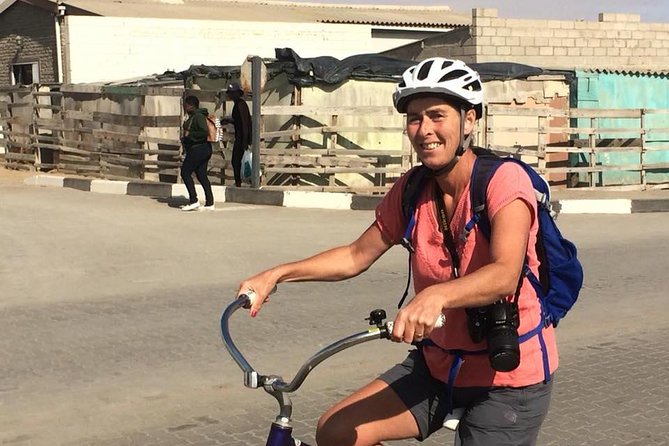
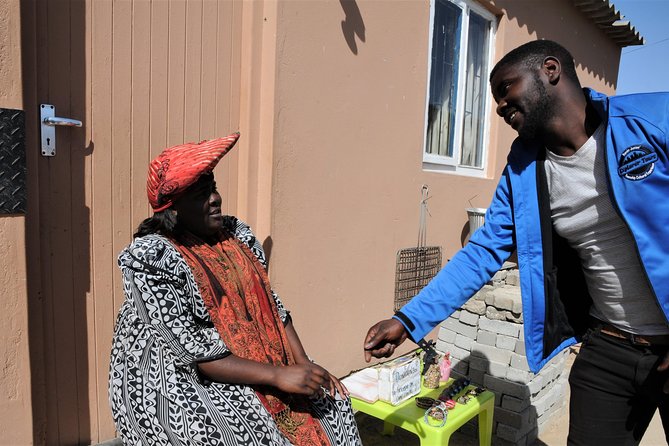
A central purpose of the outing is to introduce you to traditions connected with Owambo, Damara, and Herero communities. The emphasis is conversational and practical. You may learn about traditional dress, hear explanations of local customs, and see how different cultural identities are represented in the township.
That makes the guide especially important. Names, clothing, language, and food all carry meaning, and a good explanation helps you understand the difference between observing a tradition and treating it as a display. The strongest comments about Frans describe him as someone who makes history approachable and human.
The Damara Nama clicking language demonstration is one of the most unusual parts of the experience. You do not merely hear about it. You have the chance to try the sounds yourself. Expect laughter, because clicking unfamiliar sounds is not easy for most first-time visitors, but the humor is part of the exchange rather than a substitute for learning.
I would approach this section with curiosity and patience. You may not master the language in one short visit, and the tour does not promise a formal language lesson. Its value is the introduction, the chance to hear the sounds from a local person, and the reminder that Namibia contains many languages and cultural traditions.
More things to do in Walvis Bay:
- Walvis Bay: 4×4 Desert Excursion to Sandwich Harbour Bay
★ 4.8 · 446 reviews - Walvis Bay: Sandwich Harbour Half-Day 4×4 Scenic Excursion
★ 5.0 · 426 reviews - Pelican Point Kayaking Half-Day Tour
★ 5.0 · 349 reviews - Walvis Bay: Pelican Point Kayaking Tour
★ 4.7 · 171 reviews
Lunch at a local family home

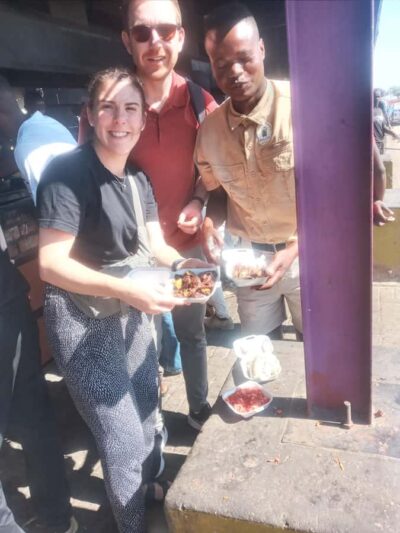
The family-home lunch is the most personal part of the day. You are invited into a local home to taste traditional Oshiwambo food and drink, with the meal included in the price. The food is described as a selection of local dishes rather than a single named specialty, so you should expect a sampling of traditional cooking.
This stop is valuable because eating together creates a natural opening for conversation. You can ask questions, notice how hospitality is shared, and experience food in a home setting rather than receiving a standard restaurant meal. A small singing group may also serenade the table with a cappella music, turning lunch into both a meal and a cultural exchange.
I like the fact that the food is part of the community visit, not an unrelated buffet added for convenience. It gives the tour a human scale. You are not rushing from one photo stop to the next. You have time to sit, taste, listen, and respond.
Still, remember that eating in a family home is different from choosing from a restaurant menu. The supplied information does not provide a list of ingredients or dietary options. If you have allergies, religious food rules, or other restrictions, tell the operator in advance and ask what can be accommodated.
The DRC kindergarten and children’s performances
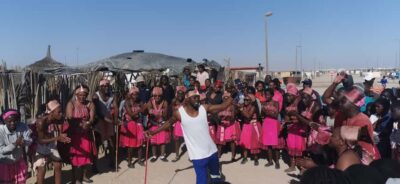
The itinerary includes a visit to the DRC kindergarten, where children play and may sing or dance. This can be a joyful part of the outing, and the music has been one of the most praised elements of the experience.
At the same time, I would encourage you to keep your approach respectful. A school or kindergarten is a place where children spend their day, not simply a performance venue. Follow the guide’s instructions about photography, interaction, and where to stand. The information does not state a formal donation arrangement or a set performance schedule, so do not assume either.
The children’s singing and dancing can show how music is woven into community life. It also adds a welcome change of pace after the historical explanation and language demonstration. You get to see energy and play rather than only hearing about customs.
The description refers to children at both stops, suggesting that more than one child-focused visit may occur. Exact timing is not provided, so the day may vary depending on school activity and local arrangements. That flexibility is part of the experience, but it also means you should not expect every performance to run like a scheduled concert.
Ending with the Mondesa choir
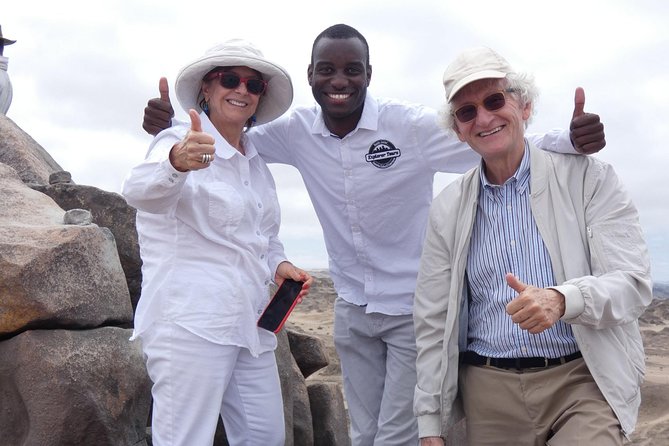
The tour finishes with a live performance by a local choir from Mondesa. Strong feedback gives this closing a major share of the praise, especially for the singing and the way it completes the day.
Music works well as the final stop because it brings together several themes from the tour: language, community, welcome, and shared identity. After hearing about the township and meeting people in smaller settings, you finish by listening to a larger group perform.
One of the most useful details is that Frans is also a singer. That suggests the musical side of the tour is not an afterthought for him. If you enjoy vocal music, this may be the part you remember most clearly.
The description does not state how long the choir performs or name the songs. Keep your expectations simple: this is a local performance included in a cultural tour, not a full evening concert. Its appeal is the setting and connection to the community.
What the $82.06 price includes
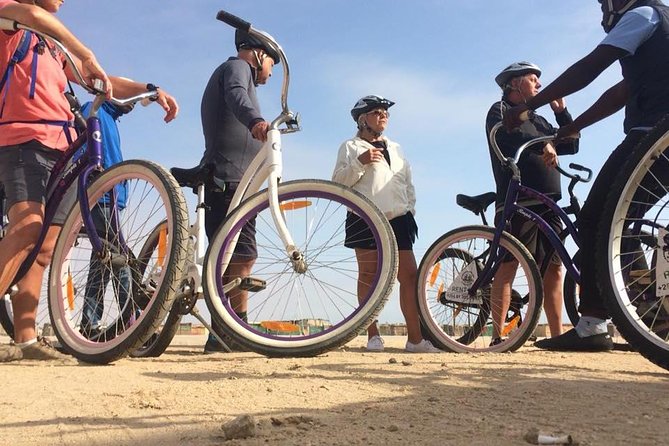
At $82.06 per person, the cost is not the lowest way to spend a morning in Swakopmund. The value comes from what is bundled together: a private guide, transport by bicycle or car, a family-home lunch, access to local cultural experiences, and the choir performance.
The private format is important. Your group is limited to ten people, and only your party participates. That should make it easier to ask questions and avoid the impersonal feel of a large bus excursion. A minimum of two people is required, so solo visitors cannot book it as a one-person outing under the stated terms.
I see the price as reasonable if you care about personal contact and want more than a drive past township streets. Lunch alone is not the reason to book. The real value is the combination of local introductions, food, music, and historical context in a single half-day.
The value is weaker if you are mainly seeking formal sightseeing or a highly structured historical tour. The itinerary gives you one detailed colonial-era stop, but the main focus is community contact. You are paying for the people and the encounters as much as for the transport.
Communication and timing deserve attention
The experience has received high marks for the guide, food, music, and local contact, but communication has not been consistent for everyone. One customer missed the tour after confusion about the meeting point and believed the operator could not access the cruise pier pickup area. Another customer reported a last-minute cancellation and a delayed refund.
The operator disputed the meeting-point complaint and said the guide was waiting at the agreed location. That difference tells you exactly what to do: confirm the meeting point, pickup limits, and contact number in writing before the morning of the tour.
Cruise passengers need particular care. One cruise group arrived two hours late, and Frans waited for them, which is encouraging. But you should not treat that as a guaranteed policy. Ask what happens if your ship is delayed and where you are expected to meet the guide.
Free cancellation is available up to 24 hours before the start time. Changes or cancellations inside that 24-hour window are not accepted for a refund. The experience also depends on good weather and a minimum number of participants. If the operator cancels for either reason, you should be offered another date, another experience, or a full refund.
Who should book this Mondesa experience?
I would recommend this tour to you if you want conversation, food, music, and a local perspective on Swakopmund. It suits couples, families, and small groups who appreciate a flexible outing and do not need every minute planned in advance.
It is also a good match if you have already seen the town’s main colonial sights and want to understand more about present-day community life. The Owambo, Damara, and Herero introductions, the clicking demonstration, and the home meal give the morning a wider frame.
You may want to choose another outing if your main interest is wildlife, desert scenery, architecture, or a long list of formal monuments. This tour is not designed around spectacular views or strenuous activity. Its strongest moments come from people, voices, food, and shared time.
FAQ
Where does the tour take place?
The experience takes place in and around Mondesa in Swakopmund, with historical and cultural stops connected to Swakopmund and its communities.
How long does the tour last?
The tour lasts approximately four hours. Customized versions are described as lasting three hours or longer.
What time does the tour start?
The stated start time is 10:00 am.
Is pickup included?
Pickup is offered in Swakopmund only. The provided information does not include pickup from Walvis Bay or confirm access to a cruise pier, so you should confirm the meeting point before booking.
How many people can join?
A minimum of two people is required per booking, and the maximum is ten people. The activity is private for your group.
Is lunch included?
Yes. Buffet lunch is included, with traditional Oshiwambo food and drink served at a local family home.
Can I cancel for a full refund?
Yes, if you cancel at least 24 hours before the experience start time. Cancellations or changes made less than 24 hours in advance are not accepted for a refund. Poor weather or failure to meet the minimum number of participants may lead to another date, another experience, or a full refund.
Should you book this tour?
Book it if you want a people-centered half-day with local food, language, children’s music, and a Mondesa choir. The strongest reasons are the family-home lunch, the Damara Nama clicking demonstration, and the warm guiding style associated with Frans.
Before paying, confirm the Swakopmund meeting point, especially if you arrive by cruise ship or are staying in Walvis Bay. If that detail is settled, this tour offers a thoughtful way to see a side of the area that ordinary sightseeing rarely reaches.
Just added in Walvis Bay
- Walvis Bay : Pelican Point Birding and Cape Fur seal tour★ 5.0 · 1 review
- Walvis Bay: Seal Kayaking Adventure with Brunch★ 4.1 · 3 reviews
- Walvis Bay: Half-Day Tour with Dune 7 and Pink Lake★ 4.6 · 11 reviews
- Walvis Bay: Mondesa Township Tour★ 3.7 · 13 reviews
- Wildlife and Landscape Tour- full-day (7hours) from Walvis Bay★ 5.0 · 5 reviews
- Birding Tours in Walvisbay and surrounds★ 5.0 · 1 review
- Walvisbay & Coastal Town City Private Local Guided Day Tour for Cruise Ships★ 3.5 · 11 reviews
- Shore Excursion – Flamingos ,Dune7,Welwitschia, Moonlandscape,Oasis,Swakopmund.★ 5.0 · 8 reviews
Township Tours, compared.
Half-Day Windhoek City and Township Cultural Tour
Read our review →

Swakopmund Best Cultural Historical Township Tours Namibia
Read our review →
Katutura:tours and transport around the townships
Read our review →Browse the lists this tour appears in