
Reviewed · LIVING DESERT TOURS
From Swakopmund: Living Dunes Experience
Small creatures make big impressions. This 3.5-hour trip into the Namib’s coastal dunes shows you a side of Namibia that most wildlife outings miss: geckos, lizards, snakes, chameleons, spiders, scorpions, and beetles that survive where almost nothing seems to grow. I like the expert animal tracking and the chance to see the dunes as a living place, not just endless sand. I also like the short dune drive at the end, which adds a little speed to a mostly slow and careful search. The main drawback is that this is a walking and sand-based outing, so it is not suitable for people with mobility impairments.
You’ll be collected at your Swakopmund accommodation and driven only a few minutes to the coastal dune belt. The price is $61 per person, including transport, a guide, and still mineral water. That is a fair deal for a focused half-day trip, especially if you value close-up nature and clear explanations more than big-animal sightings. Guides including Johnny, Björn, Immanuel, and others have been praised for their humor, care with the animals, and ability to find several of the desert’s small five.
In This Review
- Key things to know before you book
- Why this short dune trip is worth your time
- Leaving Swakopmund for the coastal dunes
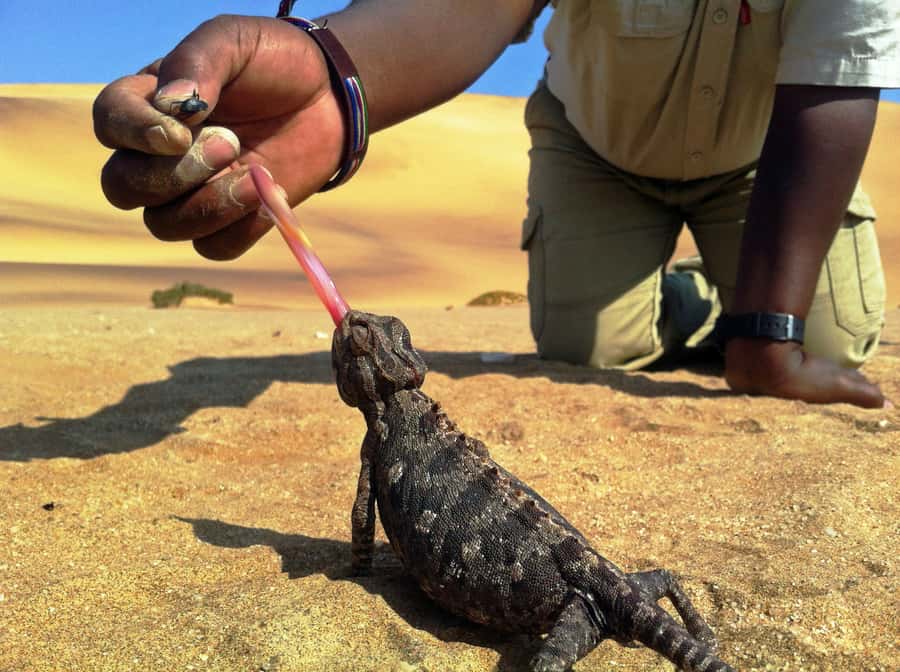
- Searching for the Namib’s small five
- The guide is the heart of the experience
- A closer look at the dune scenery
- The final 15-minute ride adds a change of pace
- What the $61 price includes
- Comfort, clothing, and practical limits
- Who will enjoy this most
- Should you book the Living Dunes Experience?
- FAQ
- Where does the Living Dunes Experience take place?
- How long does the tour last?
- Does the tour include hotel pickup?
- How long is the drive to the dunes?
- What animals might I see?
- Is a dune drive included?
- What language is the tour conducted in?
- Is food included?
- What should I bring?
- Is the activity suitable for people with mobility impairments?
Key things to know before you book
- The dunes are only five minutes from Swakopmund: You spend little time in a vehicle and most of the outing exploring the sand on foot.
- The guide makes the difference: Finding a Palmato gecko or tok-tokkie beetle takes a trained eye, patience, and knowledge of tracks.
- You may see several small desert species: Possible finds include geckos, lizards, snakes, chameleons, spiders, scorpions, and beetles.
- The outing explains survival, not just sightings: You learn how animals cope with heat, dryness, shifting sand, and scarce food.
- A short dune drive adds variety: The final vehicle section gives you scenic views and a faster look at the dunes.
- Bring sun protection: Sunscreen and a hat are listed as essentials, and there is no food included.
Why this short dune trip is worth your time
Swakopmund is often used as a base for ocean cruises, desert drives, and larger wildlife excursions. Those are good reasons to visit, but they can leave you with a narrow idea of Namibia’s nature. The Living Dunes Experience changes the scale. Instead of scanning for antelope or elephants, you look down at the sand and search for signs of life measured in tracks, shadows, burrows, and sudden movement.
That change in focus is the main reason I would recommend this outing. The Namib is ancient and is home to a remarkable number of species found nowhere else. A pile of sand can look empty until a guide points out a lizard vanishing below the surface or a beetle positioned to collect moisture from coastal fog.
The experience is also a useful lesson in how deserts work. You are not simply shown an animal and given its name. The guide explains the adaptations that help each creature live in a dry coastal environment. That may include how animals move across loose sand, how they hide from heat, or how they make use of limited moisture.
You should set your expectations correctly. This is not a guaranteed checklist tour. Small desert animals are wild, well camouflaged, and affected by conditions. The guide’s skill improves your chances, but nature still has the final say. That uncertainty is part of the appeal, though it may frustrate you if you want constant action.
More Living Desert trips in Swakopmund:
- Swakopmund: Little Five Desert Wildlife Quad Biking Tour
★ 4.8 · 123 reviews - Living Desert Eco Dune Tour
★ 5.0 · 113 reviews - Living Dunes Experience from Swakopmund
★ 4.5 · 76 reviews
Leaving Swakopmund for the coastal dunes
Pickup is provided at your accommodation in Swakopmund. The first vehicle ride is listed as about five minutes, so you are quickly beyond the city and into the coastal dune belt. This short transfer is useful because it leaves nearly the full three hours and twenty-five minutes for the actual outing.
As you drive out, you can begin noticing how quickly the setting changes. Swakopmund gives way to open sand, and the familiar town becomes a distant starting point. The nearby location also makes this easy to fit into a morning or afternoon without giving up an entire day of sightseeing.
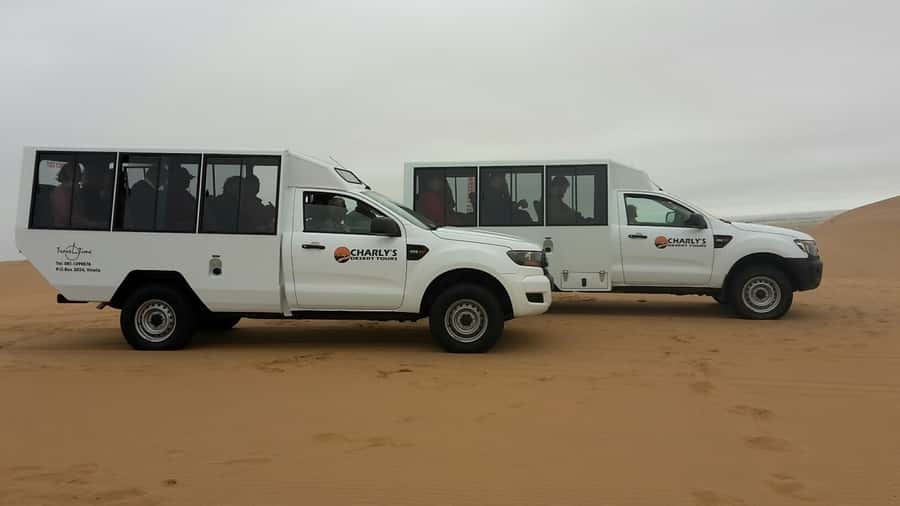
You travel in a jeep or SUV. The vehicle is used for the short approach, the scenic drive, and the return to town. The transport is practical rather than the main attraction. The real value begins when you get out and start examining the sand.
A safety briefing takes place before the walking portion. Pay attention to it. The dunes can look gentle, but loose sand makes walking harder than it appears, and the outing includes searches for snakes, spiders, and scorpions. The information provided does not specify the group size, so you may want to confirm that detail when booking if it matters to you.
Searching for the Namib’s small five
The central part of the activity is a guided walk and search in a secluded dune area. The word search matters. You are not following a fixed trail past display points. You may stop to inspect a track, watch a patch of sand, or follow a clue that would be easy to miss without help.
This is where the guide’s experience becomes essential. The desert animals are small and often blend into their surroundings. A trained guide can read the marks left by something moving beneath or across the sand and can explain what you are looking at before the animal disappears.
The possible sightings make the outing varied:
- Palmato geckos, small reptiles adapted to desert conditions
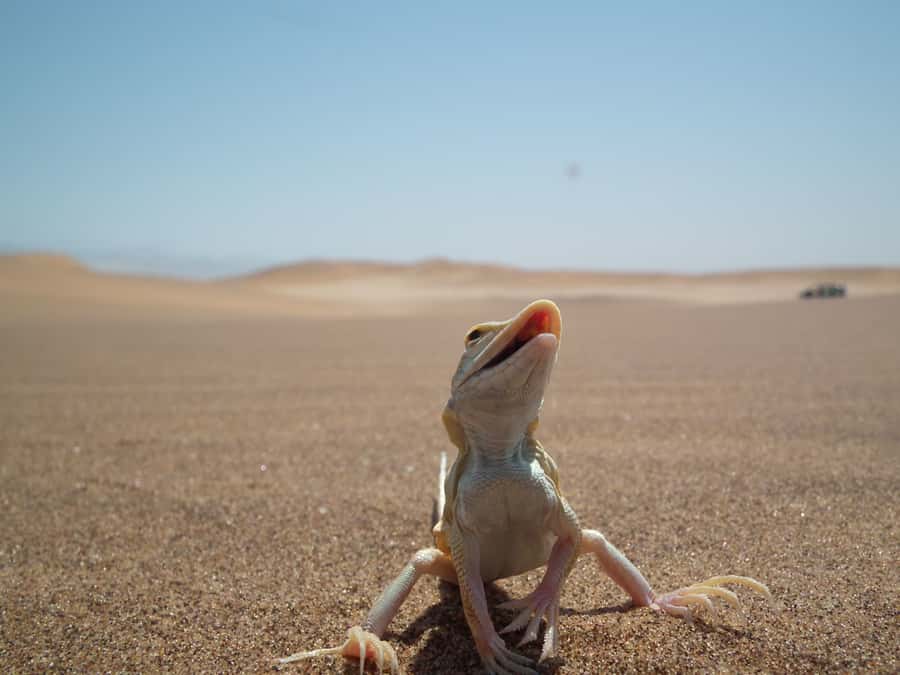
- Sand-diving lizards, which can move into loose sand with surprising speed
- Tok-tokkie beetles, famous for collecting moisture from coastal fog
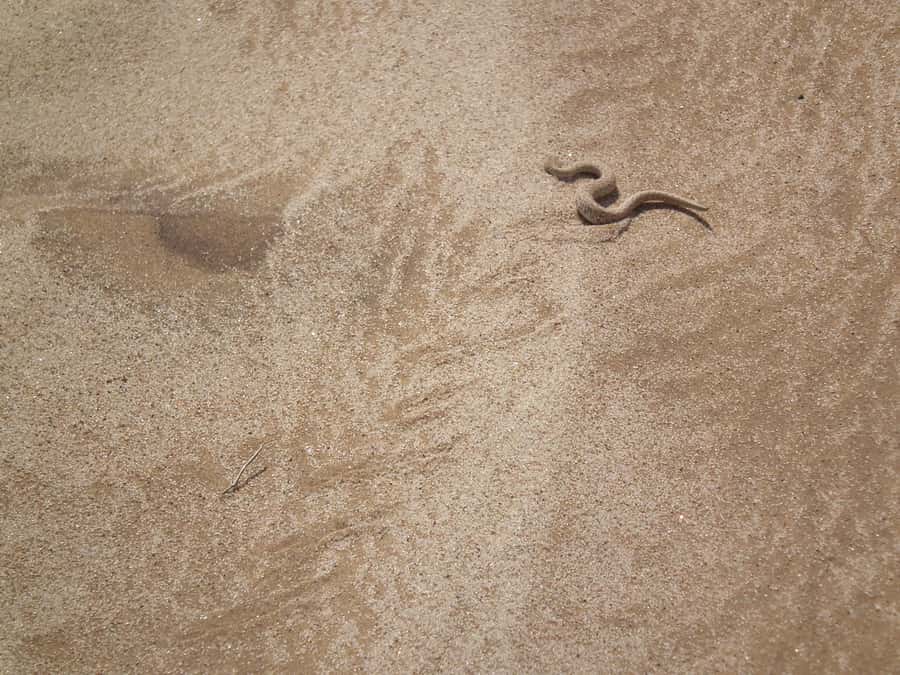
- Sidewinder snakes, whose movement leaves distinctive patterns in the sand
- Spiders and scorpions
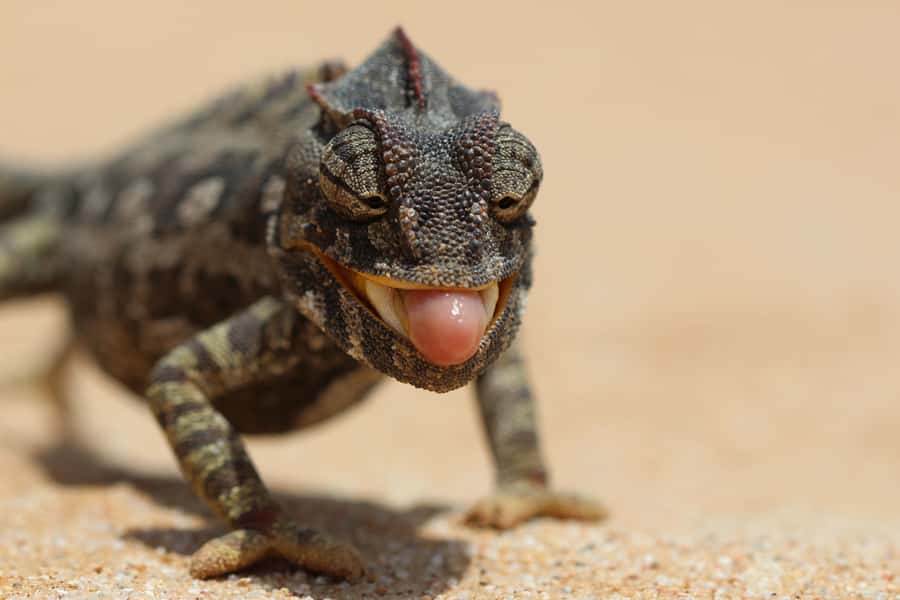
- Chameleons and other small reptiles
The beetle is one of the most interesting examples because it connects the dune animals to the coast. Fog may seem like a minor weather feature, but in this dry region it can provide an important source of moisture. The guide uses examples like this to show you that desert survival is based on small, precise solutions.
You may also learn to identify tracks and other subtle signs. That skill changes how you see the dunes. Before the tour, an empty slope is simply an empty slope. Afterward, a line in the sand may suggest a snake, lizard, or beetle passed through recently.
The guide is the heart of the experience
A good guide is not an extra benefit here. A good guide is the experience. The animals are difficult to spot without someone who understands their behavior, habitat, and tracks.
The strongest praise has gone to guides who combine clear information with a light touch. Johnny has been noted for finding the small five, explaining each animal carefully, handling wildlife with caution, and adding humor. Björn has been praised for explaining a great deal and showing the group plenty. Immanuel was singled out for being both funny and highly capable, finding four of the small five during one outing.
Those details tell you what to look for. The best part is not simply seeing an animal. It is seeing how the guide locates it, learning why it is there, and watching it being treated with care. The supplied information repeatedly emphasizes that the guides are passionate about protecting Namibia’s natural world.
English is the stated tour language. If you are comfortable following an English-speaking guide, you should receive the full explanation of the animals and their adaptations. The positive feedback includes German-speaking customers, but the official language for the activity is English.
More things to do in Swakopmund:
- Walvis Bay: Marine Big 5 Luxury Catamaran Tour
★ 4.8 · 1,012 reviews - Swakopmund: Desert Dunes Quad Biking with Optional Sandboard
★ 4.9 · 590 reviews - Walvis Bay and Sandwich Harbour Tour
★ 4.8 · 483 reviews - Scenic Sandwich Harbour Tour
★ 5.0 · 277 reviews
A closer look at the dune scenery
The scenery here is spare and dramatic. You get broad sand slopes, changing patterns, and open views with little visual clutter. The dunes are especially good for photography because the light picks out ridges and tracks, while the animals provide a subject far smaller than the setting around them.
The photo opportunities are not limited to wildlife. You can photograph the curves of the dunes, the marks left by moving creatures, and the contrast between a tiny beetle and a vast field of sand. A camera with a useful close-focus setting may help, though the available details do not specify any equipment or photography arrangements.
Still, do not treat this as a dedicated photography workshop. The group is moving, searching, listening, and learning. You may have a short chance to photograph an animal before it moves or buries itself. Patience will help, and you should follow the guide’s instructions rather than crowding or touching the creatures.
The dunes can also be visually deceptive. Their beauty is obvious, but their ecology is easy to miss. The guide’s role is to reveal the activity beneath the simple surface. That is what gives the scenery meaning.
The final 15-minute ride adds a change of pace
After the wildlife search and walking portion, the tour includes a short drive over the dunes. The stated return vehicle time is about 15 minutes. It is not a full-day 4×4 adventure, so you should not book this expecting a long, high-speed off-road ride.
Instead, think of it as a compact finish. After moving slowly while tracking animals, you get a quicker view of the dunes from the vehicle. The change of pace rounds out the outing and gives you a final chance to enjoy the scenery without concentrating on every mark in the sand.
This balance works well for a 210-minute activity. The walking section provides the substance, while the drive prevents the experience from feeling repetitive. If your main goal is an extended dune-driving adventure, you may want a different excursion. If you want close nature observation with a modest vehicle component, this format makes sense.
What the $61 price includes
At $61 per person, the tour offers a reasonable value for a guided half-day from Swakopmund. Your fee includes hotel pickup and drop-off, the guide, and still mineral water. You are paying for local expertise and access to an activity that would be difficult to reproduce on your own.
The value depends on what you want from a desert outing. If you are looking for large animals, dramatic chase scenes, or a full meal, this is not the right choice. Food is not included, and the tour is centered on small creatures and interpretation.
If you enjoy nature walks, photography, reptiles, insects, and unusual ecological facts, the price looks stronger. The short transfer also matters. You are not spending much of the paid time driving to a faraway site, and the accommodation pickup removes the need to arrange your own transport to the dunes.
The free cancellation policy allows cancellation up to 24 hours before the activity for a full refund. You can also reserve and pay later, which is useful when you are arranging several Namibia activities and want to keep your schedule flexible.
Comfort, clothing, and practical limits
The two items specifically recommended are sunscreen and a hat. Take that advice seriously. You will be in exposed sand with limited shade, and the outing lasts three and a half hours.
Wear clothing that protects you from the sun and is comfortable for walking on soft ground. The supplied information does not specify footwear, temperature guidance, snack arrangements, or restroom access, so ask the operator if any of those details are important for you.
Still mineral water is included, but food is not. Have something to eat before or after the outing, depending on the start time. Since the activity can be physically demanding on loose sand, arriving prepared will make it easier to focus on the animals.
The activity is not suitable for people with mobility impairments. That restriction is important because the main portion involves walking and searching in the dunes. If you have any concern about balance, soft sand, or extended walking, contact Charly’s Desert Tours before paying.
Who will enjoy this most
I would recommend the Living Dunes Experience to you if you enjoy:
- Reptiles, insects, spiders, and other small wildlife
- Guides who explain animal behavior and survival
- Quiet nature outings rather than crowded attractions
- Photography focused on unusual subjects
- Short excursions that leave time for other Swakopmund plans
- Learning how to read animal tracks and signs
Families with older children may also find it engaging, especially if they enjoy looking closely and asking questions. The available information does not give a minimum age, so check that point directly if you are booking for young children.
This is less suitable if you need accessible terrain, dislike walking on sand, or want guaranteed animal sightings. It may also feel too slow if you prefer a long vehicle safari. The pleasure comes from observation, not spectacle.
Should you book the Living Dunes Experience?
Yes, if you want to understand how the Namib works at ground level. The $61 price is sensible for hotel transport, a specialized guide, water, and a focused three-and-a-half-hour outing so close to Swakopmund.
Book it especially if you have already seen larger Namibian wildlife and want something different. The strongest reason to go is the guide’s ability to find creatures you would almost certainly miss alone. Just bring sun protection, expect some walking on loose sand, and remember that wild sightings cannot be promised.
FAQ
Where does the Living Dunes Experience take place?
The activity takes place in the coastal dune belt just outside Swakopmund, in Namibia’s Erongo region.
How long does the tour last?
The total duration is 210 minutes, or three and a half hours.
Does the tour include hotel pickup?
Yes. Pickup and drop-off at your accommodation in Swakopmund are included.
How long is the drive to the dunes?
The initial jeep or SUV transfer is listed as approximately five minutes from Swakopmund.
What animals might I see?
Possible sightings include Palmato geckos, sand-diving lizards, tok-tokkie beetles, sidewinder snakes, spiders, scorpions, chameleons, and other small desert creatures.
Is a dune drive included?
Yes. The activity finishes with a short dune drive, followed by the return transfer to Swakopmund.
What language is the tour conducted in?
The live tour guide language is English.
Is food included?
No. Food is not included, but still mineral water is provided.
What should I bring?
You should bring sunscreen and a hat.
Is the activity suitable for people with mobility impairments?
No. The activity is listed as not suitable for people with mobility impairments because the main portion involves walking and searching in the dunes.
Just added in Swakopmund
- Windhoek: Township Tour amongst the locals★ 4.0 · 1 review
- Walvis Bay Shore Excursion: Flamingos, Dune 7, Swakopmund★ 5.0 · 3 reviews
- Unforgettable Half Day Adventure, Explore Sandwich Harbour★ 5.0 · 3 reviews
- Swakopmund Township Home Cooking Experience★ 5.0 · 1 review
- Swakopmund Explorer Township Tour in Mondesa with Nande the Township Local Guide★ 5.0 · 4 reviews
- Walvisbay Dune 7 and Swakopmund Town Half Day Guided Tour★ 4.0 · 4 reviews
- Spitzkoppe – Day Tour to the Spitzkoppe Mountain from Swakopmund★ 5.0 · 3 reviews
- Sandwich Harbour 4×4 Guided Tour – Unforgettable Adventure★ 5.0 · 7 reviews
Living Desert Tours, compared.
Browse the lists this tour appears in